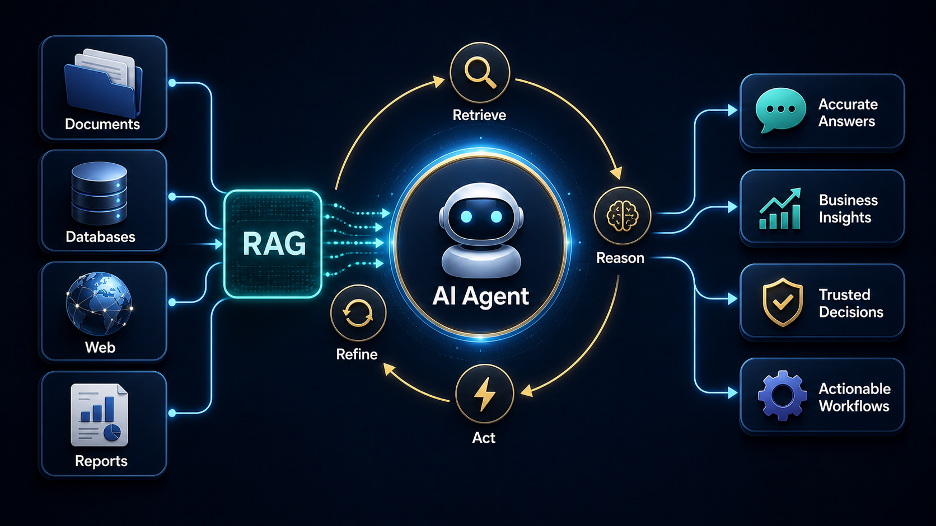
What Is RAG—and How Do Agents Use It?

What Is RAG—and How Do Agents Use It?

As AI becomes more capable, one challenge continues to stand out: how do we make AI systems accurate, current, and trustworthy? This is where a concept called RAG (Retrieval-Augmented Generation) comes in. And when you combine RAG with agentic workflows, you unlock a powerful way to build smarter, more reliable systems.

Let’s break it down in simple terms.

What Is RAG?

RAG stands for Retrieval-Augmented Generation.

It’s a method that allows AI to:

  • Retrieve relevant information from external sources (documents, databases, the web)
  • Use that information to generate a better, more accurate response
  • Instead of relying only on what it “learned” during training, a RAG system can look things up in real time.

A Simple Way to Think About It

Imagine asking a question:

“What are our company’s latest sales numbers?”

A regular AI model might:

  • Guess based on old patterns or say it doesn’t know

A RAG-enabled system will:

  • Search your internal database
  • Pull the latest data
  • Use that data to generate a precise answer

It’s like giving AI access to a library—and teaching it how to use it.

Why RAG Is Important

RAG solves several major problems in AI:

  • Keeps Information Up-to-Date
    • AI without RAG can become outdated.
    • RAG ensures responses reflect the latest available data.

Improves Accuracy

  • Instead of guessing, the system uses real sources to respond.

Enables Custom Knowledge

You can connect AI to:

  • Company documents
  • Policies
  • Knowledge bases
  • Reports

This makes AI context-aware and organization-specific.

Builds Trust

  • When responses are grounded in real data, users are more likely to trust the output.

Where Agents Come In

Now let’s take this a step further.

RAG alone is powerful—but when combined with agents, it becomes transformative.

An agent is an AI system that can:

  • Decide what to do
  • Take actions
  • Use tools (like RAG systems)
  • Adapt based on outcomes

So instead of just answering questions, agents can actively use RAG as part of a workflow.

How Agents Work with RAG

Think of RAG as a tool, and agents as the decision-makers using that tool.

Here’s how the interaction typically works:

Step 1: Understand the Goal

The agent receives a task:

  • “Prepare a summary of customer feedback from last quarter.”

Step 2: Decide to Retrieve Information

The agent realizes:

  • “I need data from reports and feedback databases.”

Step 3: Use RAG to Retrieve Data

  • The agent queries relevant sources
  • Retrieves documents, reviews, or datasets
  • Selects the most relevant content

Step 4: Generate Insights

  • Using the retrieved information, the agent:
  • Summarizes key themes
  • Identifies trends
  • Generates a clear report

Step 5: Refine or Iterate

  • If needed, the agent:
  • Retrieves additional data
  • Clarifies missing details
  • Improves the output

Real-World Examples

Business Reporting

An agent:

  • Uses RAG to pull financial data
  • Combines it with market insights
  • Generates a full executive summary
  • Result: Faster, data-driven decision-making

Healthcare Support

An agent:

  • Retrieves medical guidelines
  • Pulls patient history (securely)
  • Assists professionals with contextual recommendations
  • Result: More informed and consistent care

Government Services

An agent:

  • Retrieves policies and regulations
  • Answers citizen questions accurately
  • Guides users through applications
  • Result: Better public service delivery

Developer Workflows

An agent:

  • Retrieves documentation
  • Pulls code examples
  • Suggests solutions
  • Result: Faster problem solving and development

Why This Combination Matters

RAG gives AI knowledge access.

Agents give AI decision-making ability.

Together, they create systems that are:

  • Informed (they know where to get the right data)
  • Autonomous (they decide when and how to use it)
  • Adaptive (they improve based on context)

This is a major step forward from simple chatbots or static automation.

Final Thoughts

RAG and agents are not just technical upgrades—they represent a shift in how AI systems operate.

  • RAG connects AI to real-world knowledge
  • Agents turn AI into active problem-solvers

Together, they move AI from answering questions to understanding, reasoning, and acting with context.

As businesses and governments adopt these systems, we’ll see AI that is not just smarter—but more useful, reliable, and aligned with real-world needs.

AI Workforce for Construction and Property Management

Let’s talk about how WorkCore AI can support the core of your operations.