Managing a property portfolio has always meant orchestrating dozens of moving parts — tenant requests, maintenance schedules, ownership reporting, and vendor coordination — often across organizations that barely share a phone call, let alone a data layer. Construction projects compound the challenge: estimates, trade scheduling, site supervision, and owner sign-offs each travel through their own siloed channel.
WorkCore takes a different approach. Rather than asking humans to bridge these silos manually, it deploys a network of specialized AI agents on each side of the relationship — property management and construction — and lets them coordinate automatically, escalating only when a human decision is genuinely required.
WorkCore’s agent architecture connects property managers, tenants, contractors, and owners through a mesh of specialized AI — turning fragmented workflows into a single, self-coordinating system.
PROPERTY MANAGEMENT SIDE
On the property management side, four agents divide responsibilities cleanly. The Tenant Agent fields incoming requests, the Property Manager Agent routes and prioritizes them, the LeasingAgent handles occupancy and prospecting, and the Owner Agent surfaces the financial and operational picture to ownership. Dashed lines in the diagram represent the human touch points — the property manager and owner — who receive summaries and approve decisions rather than wading through raw communication threads.
Property Management Agents
Tenant Agent: Receives maintenance requests, answers FAQs, and escalates urgent issues to the property manager.
Property Manager Agent: Triage hub. Classifies requests, assigns to Leasing or Owner agents, and dispatches work orders to the construction side via WorkCore.
Leasing Agent: Manages inquiries, screens applicants, and keeps occupancy data current for ownership reporting.
Owner Agent: Synthesizes financial and operational summaries and flags decisions that need owner approval.
CONSTRUCTION SIDE
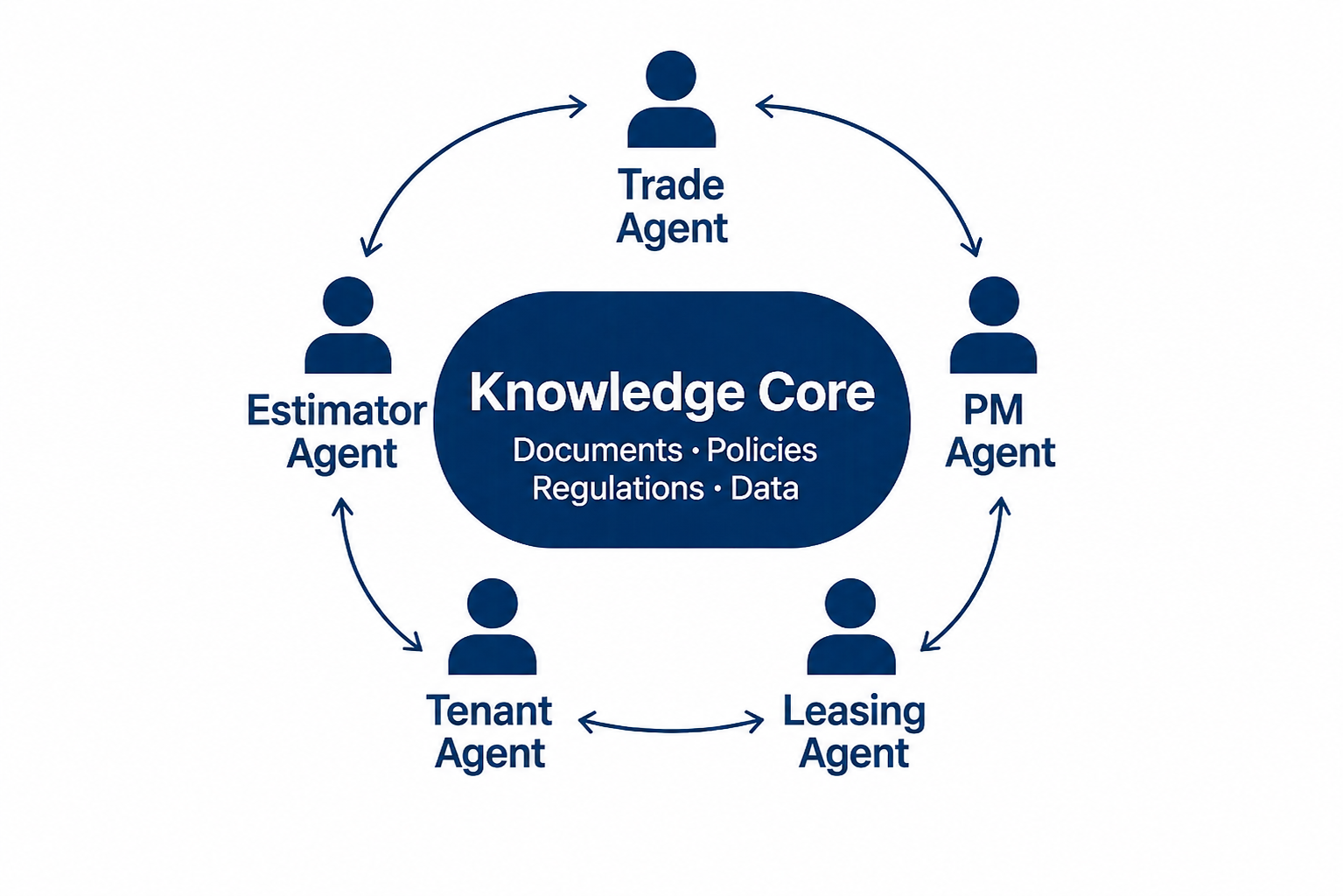
When the Property Manager Agent determines that a repair requires a licensed contractor, it hands the job to WorkCore’s bridge layer, which surfaces it inside the construction company’s own agent network. Here below are the four agents closing a construction workflow loop.
Construction Agents
Project Manager Agent: Tracks milestones, flags delays, and keeps the site manager informed without manual status updates.
Owner Agent: Relays budget data and change-order requests to the construction company owner for approval.
Estimator Agent: Pulls material pricing, generates estimates, and revises figures as scope changes — in real time.
Trade Agent: Matches work orders to available vendors and tradespeople, confirms scheduling, and tracks completion.
“The real breakthrough isn’t any single agent — it’s the mesh. Each agent handles its domain; WorkCore handles the handoffs.”
The architecture in the diagram encodes a principle that’s easy to miss at first glance: humans appear only at the edges. Property managers, owners, tenants, site managers, and vendors each interact with one agent — their own — rather than navigating a shared system designed around someone else’s workflow. The agents carry context across the boundary, so no information is lost in translation.
For property management companies, this means faster response times to tenants and cleaner reporting to owners, without hiring more coordinators. For construction companies, it means fewer surprise scope changes and tighter vendor coordination. For the relationship between the two — historically conducted over email chains and missed calls —it means a live, auditable thread that neither party has to maintain manually.
Multi-agent systems aren’t new, but applying them to the messy, cross-organizational workflows of real estate and construction — where relationships, liability, and timing all intertwine —represents a meaningful step forward. WorkCore’s architecture suggests what that step looks like in practice.