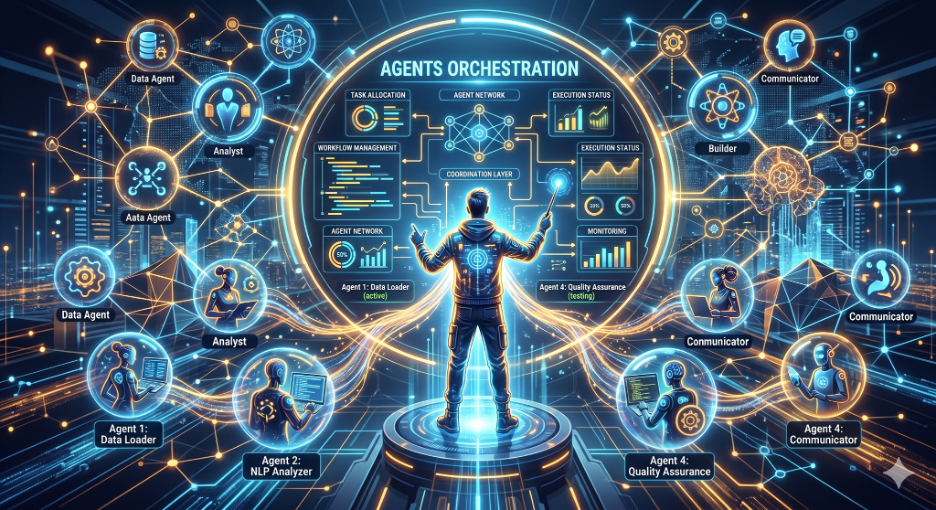
As a company owner, I spend a lot of time thinking about efficiency, innovation, and how technology can truly transform the way we work. Over the past year, one concept has stood out more than anything else: agent orchestration. While it may sound technical, the idea is simple—and incredibly powerful.
Let me explain it in a way that makes sense for everyone.
What is Agent Orchestration?
Imagine an orchestra. You have many talented musicians—each with a specific role: violinists, drummers, pianists. Individually, they are skilled. But without a conductor, the music becomes chaotic.
Agent orchestration works the same way.
Instead of a single AI doing everything, multiple specialized agents collaborate toward a common goal.
Why This Matters to Everyday People
You don’t need to be a developer to benefit from this. In fact, most people will experience agent orchestration without even realizing it.
Here are a few examples:
Work Efficiency
Imagine asking a digital assistant:
“Prepare a weekly sales report.”
Behind the scenes:
And you get a polished report in minutes.
Smarter Personal Assistants
Planning a trip could look like:
All coordinated seamlessly.
Better Decision-Making
Businesses—including mine—are starting to use orchestrated AI systems to:
Instead of relying on one tool, we rely on a team of intelligent tools working together.
The Business Perspective
From a company standpoint, this shift is huge.
In the past, we built systems to do one thing well. Today, success comes from connecting multiple capabilities into a cohesive, intelligent workflow.
Agent orchestration enables:
It’s not about replacing people. It’s about amplifying what people can do.
Challenges to Keep in Mind
Of course, like any powerful tool, orchestration comes with responsibility:
These are areas where thoughtful design matters.
Looking Ahead
We are moving toward a future where AI isn’t just a tool—it’s a collaborative ecosystem.
In that future:
And just like a great orchestra, the magic won’t come from one performer—but from how well they all work together.
Final Thoughts
Agent orchestration is not a technical trend. It is a fundamental shift in how work gets done.
The takeaway is simple:
The future isn’t about one smart system.
It’s about many smart systems working in harmony.
And those who learn to orchestrate them will lead the next wave of innovation.