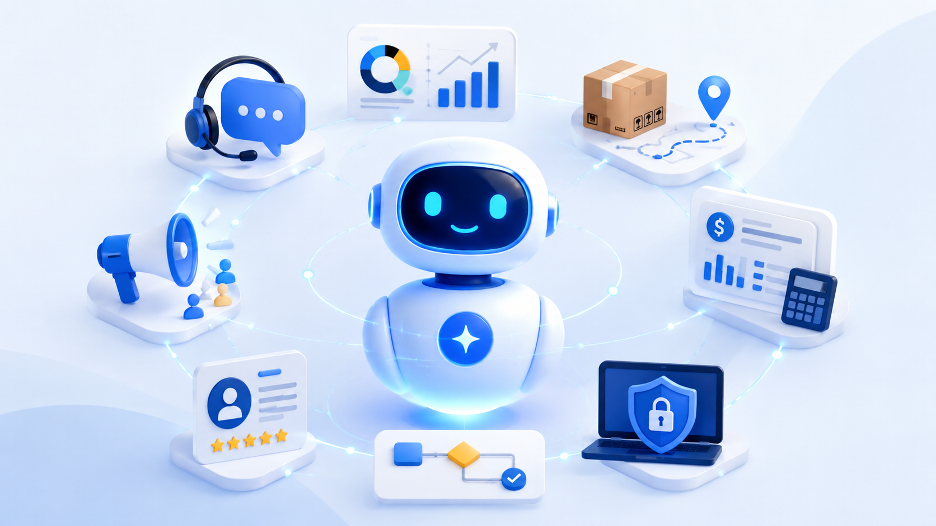
AI agents are rapidly becoming an integral part of everyday business operations across industries. Far from being experimental, these intelligent systems are now embedded in routine workflows—helping organizations operate faster, smarter, and more efficiently.
Here’s how AI agents are being used in practical, day-to-day scenarios across industries.
1. Customer Service and Support
One of the most visible applications of AI agents is in customer service. Businesses deploy AI-powered agents to handle large volumes of customer interactions.
Common uses include:
These AI agents operate 24/7, reducing response times and improving customer satisfaction while lowering operational costs.
2. Sales and Marketing Operations
AI agents play a significant role in driving growth through smarter sales and marketing activities.
Daily use cases include:
Marketing teams benefit from AI agents that continuously refine targeting strategies, ensuring better engagement and conversion rates.
3. Supply Chain and Logistics
In industries like manufacturing, retail, and logistics, AI agents are used to manage complex supply chains.
They help with:
These agents can detect disruptions (e.g., delays or shortages) and automatically adjust plans, keeping operations smooth and cost-effective.
4. Finance and Accounting
Finance teams are increasingly relying on AI agents to handle repetitive and data-intensive tasks.
Typical day-to-day uses include:
By automating these workflows, organizations improve accuracy and free up finance professionals to focus on strategic analysis.
5. IT Operations and Cybersecurity
AI agents are highly valuable in maintaining system health and security.
They are used to:
This allows IT teams to move from reactive support to proactive system management.
6. Human Resources and Workforce Management
HR departments are also benefiting from AI agents in their daily activities.
Common applications include:
AI agents help streamline administrative tasks and improve the overall employee experience.
7. Operations and Process Automation
Across industries, AI agents are used to orchestrate and optimize internal processes.
For example:
This creates more efficient, connected operations and reduces bottlenecks.
The Big Picture
What makes AI agents powerful is their ability to combine data, decision-making, and action. Unlike traditional tools, they don’t just provide insights—they act on them.
Final Thoughts
AI agents are no longer a future concept—they are already embedded in the daily rhythm of modern businesses. From customer support to supply chain management, they are quietly transforming operations behind the scenes.
Organizations that embrace these everyday use cases will not only improve efficiency but also build smarter, more agile, and more competitive businesses.