AI agents are moving from experimental chatbots to practical business systems. They can answer customer questions, support employees, analyze company information, and help leaders make decisions.
But how does an agent turn a simple human request into a useful, trustworthy response—especially when the answer depends on private or constantly changing company knowledge?
A common answer is Retrieval-Augmented Generation, or RAG.
A large language model can write, summarize, reason, and explain. However, it does not automatically know your latest policies, contracts, product documentation, financial reports, or customer history.
This creates a gap between general intelligence and organizational knowledge.
Consider a CEO asking:
“What are the main risks to launching our new product in Europe next quarter?”
A generic AI model may produce a plausible answer based on common business risks. But a useful executive response should also consider the company’s internal launch plan, regulatory assessments, sales forecasts, customer research, and operational capacity.
RAG gives the agent access to that context at the moment it is needed.
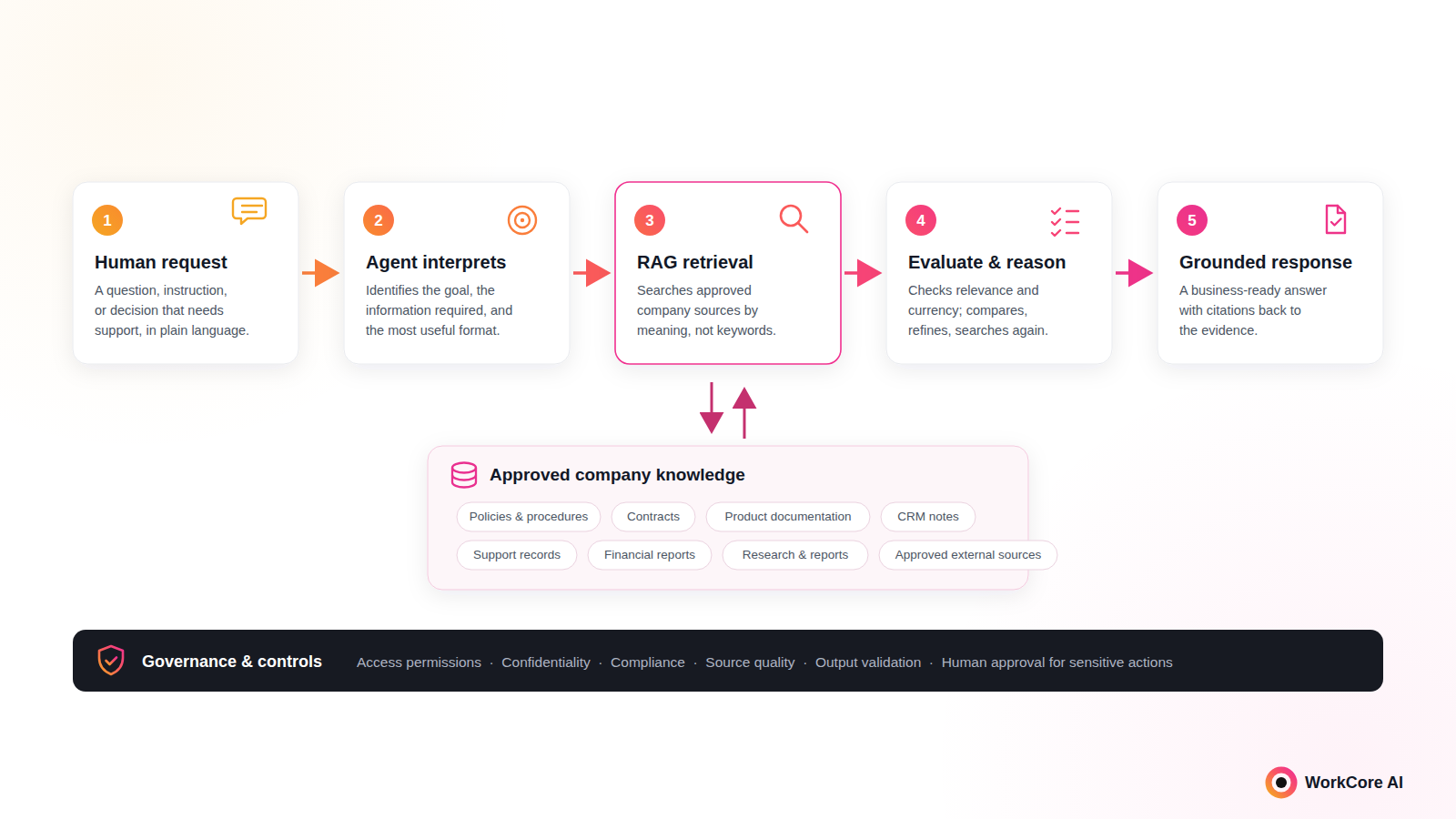
The process begins with a human request and ends with a response grounded in relevant business information.
The user communicates a goal in ordinary language. It may be a question, an instruction, or a decision that needs support.
For example:
“Summarize the most important customer concerns about our new pricing model.”
The user does not need to know where the information is stored or how to search for it.
The agent identifies:
It may recognize that “customer concerns” can be found in support tickets, sales notes, survey responses, meeting transcripts, and account management reports.
The agent is doing more than matching keywords. It translates a business request into an information-and-reasoning task.
The retrieval system searches approved company sources for information related to the request.
Documents are typically divided into smaller sections and converted into numerical representations called embeddings. These allow the system to search by meaning rather than exact wording.
For example, a customer comment saying “the new plan is too difficult to predict” could be retrieved for a search about “pricing transparency,” even though the phrases are different.
Depending on the organization, the knowledge base might include:
The retrieval layer selects the most relevant passages and sends them to the agent as supporting context.
A capable agent should not simply repeat the retrieved text. It should assess whether the information is relevant, current, sufficiently complete, and potentially contradictory.
It may also perform additional searches. For example, if customer feedback indicates that pricing is confusing, the agent might retrieve the pricing documentation and compare it with the other source.
This iterative process is one of the differences between a basic RAG chatbot and an agent. A chatbot often performs a single search and produces a single answer. An agent can plan, retrieve, compare, calculate, and revise before responding.
The language model combines the retrieved evidence with its reasoning capabilities to produce an answer.
A strong executive response might say:
“The three most common concerns are unpredictable monthly costs, difficulty comparing the new plans, and uncertainty about migration. These themes appear across customer surveys, support tickets, and sales-call notes. Enterprise customers are especially concerned about cost forecasting.”
The response may also include citations so the user can inspect the underlying evidence.
Before returning the answer, the system may apply business and security rules.
These can include:
RAG should not give every employee access to every document. Retrieval must respect the same authorization rules that govern the underlying systems.
The final result is presented in a form appropriate to the user. A CEO may receive a short executive summary with risks and recommended actions, while an analyst may receive detailed evidence and methodology.
The same knowledge can therefore support different decisions without requiring every user to manually navigate the source systems.
RAG is not merely a technical architecture. It addresses several executive concerns about enterprise AI.
The agent can use the organization’s actual information rather than relying solely on general knowledge.
Company content can be updated independently of the underlying AI model. A newly approved policy can be made available for retrieval without retraining the model.
Citations allow users to verify where an answer came from. This is especially important for financial, legal, operational, and strategic decisions.
Internal information can remain within the company's governed systems. The organization decides which sources are available and who may retrieve them.
RAG often avoids the need to train a new model for every business domain. Companies can instead connect an existing model to carefully governed knowledge.
RAG improves reliability, but it does not guarantee correctness.
The agent may retrieve incomplete information, misinterpret a document, overlook an exception, or draw a weak conclusion from accurate evidence. Poorly maintained source material will also produce poor results.
Executives should therefore treat RAG as part of a broader operating model that includes:
The quality of an enterprise agent depends as much on these foundations as it does on the AI model.
A traditional language model is like a talented new executive with broad experience but who has not read your company’s files.
RAG gives the executive access to the right briefing materials.
The agent then goes further: it identifies what it needs, finds the relevant evidence, analyzes it, and communicates a decision-ready response.
In simple terms:
Human request → interpretation → retrieval → evaluation → reasoning → controlled response
That flow is the foundation of many valuable enterprise AI systems.
The most important question for CEOs is not whether an agent can generate impressive text. It is whether the agent can reliably connect people, knowledge, and action.
When implemented well, RAG helps turn fragmented organizational information into accessible decision support. Employees spend less time searching. Customers receive faster answers. Leaders gain a clearer view of risks and opportunities.
The competitive advantage will not come from owning the same language model as everyone else. It will come from connecting AI to trusted proprietary knowledge—and embedding the resulting intelligence into how the company operates.